a multicultural Research Library
Making multicultural Australia
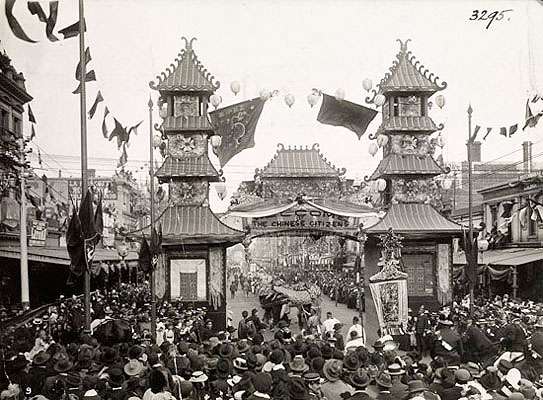
Welcome parade - celebrations of nationhood (Slide 8)
Andrew Jakubowicz.
At the end of 1901, when the Immigration Restriction Act barred further migration, there were some 2,500 living in Melbourne of a State population of 7,500. In May these 'citizens' constructed a celebratory archway, one of many gracing city intersections and welcoming to the royal visit that marked the opening of the Australia's first national Parliament.
Created:
unknown
Date Added:
03 February 2009
Source:
source not available
Format:
jpg (JPEG Image);
File size:
76 KB
Dimensions:
543 x 400
Transcript
At the end of 1901, when the Immigration Restriction Act barred further migration, there were some 2,500 living in Melbourne of a State population of 7,500. In May these ‘citizens’ constructed a celebratory archway, one of many gracing city intersections and welcoming to the royal visit that marked the opening of the Australia’s first national Parliament.
Three ceremonial dragons paraded through the city streets – a highlight of the celebrations of nationhood, according to the Melbourne Argus – and Loong, some 90 metres in length and the largest of them all came from Bendigo, not Melbourne.
State Library of Victoria collections
Chinese arch and procession picture
Accession H96.160/651 [Image Number: cc001003]
Chinese citizens arch for the Royal Visit
Photograph: gelatin silver, Harvie & Sutcliffe, 1901
View other images on Cultural Studies
 Poster for Our Backyard (slide 05)
- Victoria Religious Leaders (Slide 3)
- Sri Lankan dance - 3
- Emilio and his brother Giuseppe in ship Surriento
- Fijian-Indian gardens: replacing lost farmlands - Narendra Singh (5)
- "Brisbane Buddhas", Museum of Brisbane exhibition, 2005 (Slide 4)
View other Archival Images
- Brunswick Music Festival, 2006 (slide 03)
- Somali gardens: starting again - Asli Arab (4)
- Mabel Wong, Eunice Chinn's mother
- Chinese benefit concert for Japanese occupied China
- Vietnamese celebration - 6
- Eunice and Max joined the Army, Valda the Air Force.
Visit the multicultural Library for other documents, video, audio and images.