a multicultural Research Library
Making multicultural Australia
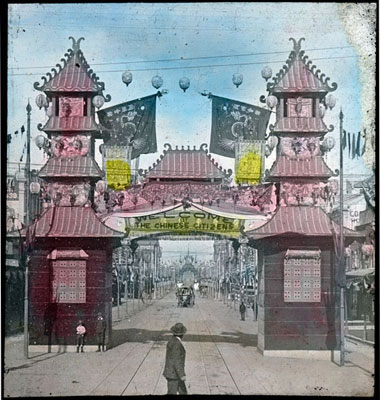
Celebratory archway
Andrew Jakubowicz.
At the end of 1901, when the Immigration Restriction Act barred further migration, there were 2,500 living in Melbourne. In May they built their own celebratory archway, one of many to grace the main city intersections to mark the opening of the Australia's first national Parliament and as a welcome to the royal visitors.
Created:
unknown
Date Added:
03 February 2009
Source:
source not available
Format:
jpg (JPEG Image);
File size:
52 KB
Dimensions:
380 x 400
Transcript
At the end of 1901, when the Immigration Restriction Act barred further migration, there were 2,500 living in Melbourne. In May they built their own celebratory archway, one of many to grace the main city intersections to mark the opening of the Australia’s first national Parliament and as a welcome to the royal visitors.
State Library of Victoria collections
Accession H91.93/76
Chinese citizens arch for the Royal Visit, Edward VII
Glass lantern slide with hand colouring; H G Myers, 1901
View other images on Cultural Studies
 The Nan Tien Temple
- Mabel Chinn with her husband Chinn Tong Coon and children Eunice, Valda and Max
- Guests at the launch of the book (Slide 1)
- Auburn West Public School (New South Wales) - anti-racism project
- Somali gardens: starting again - Asli Arab (5)
- "Brisbane Buddhas", Museum of Brisbane exhibition, 2005 (Slide 6)
View other Archival Images
- Brunswick Baths Mural (slide 10)
- Mabel Wong (15 years) and unknown man dressed for procession in Sydney, c. 1899.
- Screen for Cariba! (slide 01)
- Vietnamese celebration -3
- Brunswick Baths Mural (slide 09)
- Cane cutters, Childers 1917
Visit the multicultural Library for other documents, video, audio and images.